
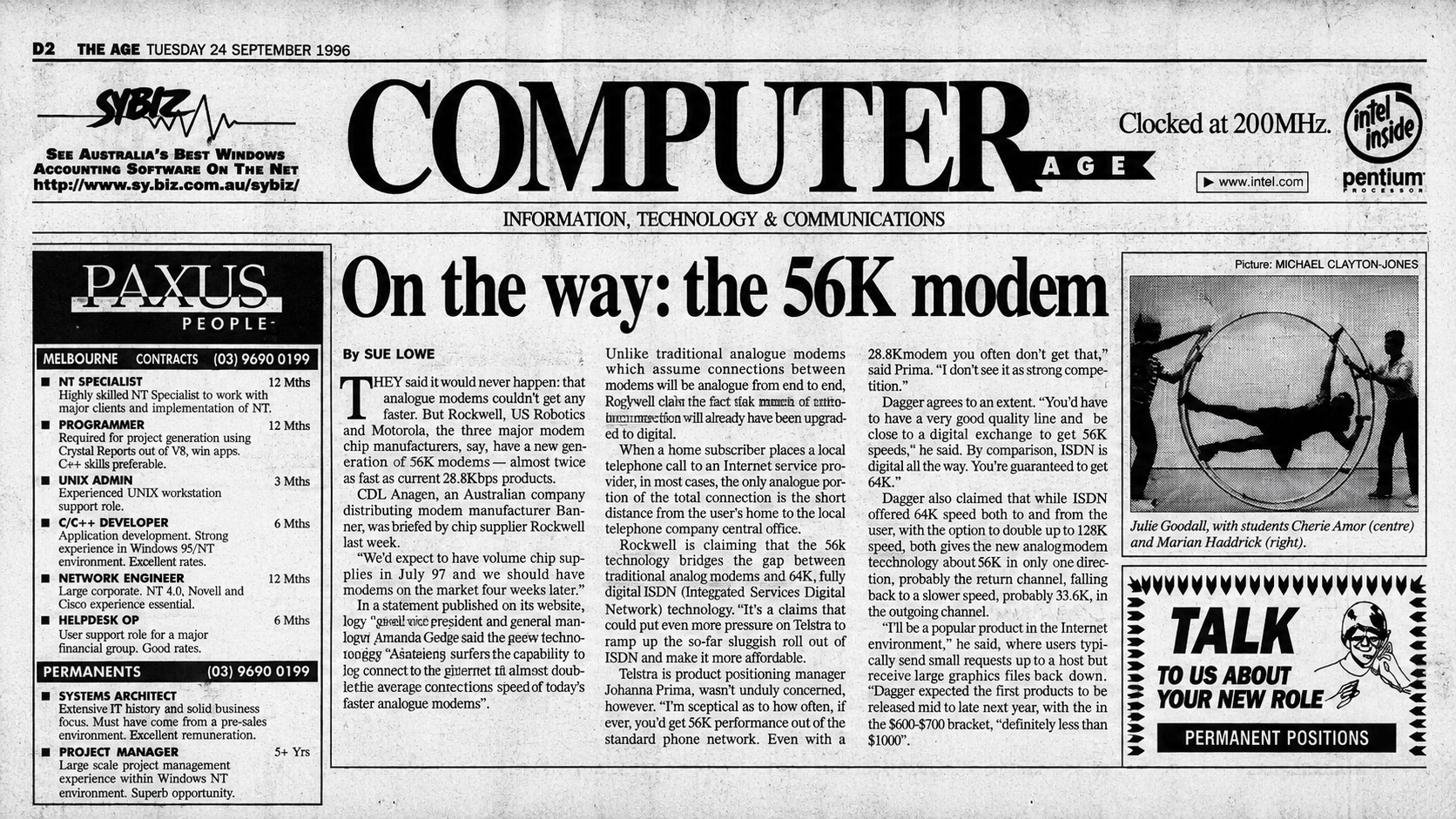
Computer Age, The Age, 24 September 1996, featuring “On the way: the 56K modem”
If you worked in IT in Melbourne in the 1990s or early 2000s, The Age on a Tuesday was one of the places to go. Its Computer Age section had the technology news, product reviews and, importantly, pages of IT job ads. Before online job boards took over, those ads were one of the main ways you saw who was hiring and which skills were in demand.
This week I went back to The Age from Tuesday 24 September 1996 to see what we were reading about 30 years ago. The paper cost 80 cents and ran to 63 pages. The Brownlow Medal had just been awarded jointly to James Hird and Michael Voss. I don't follow footy, so I quickly moved on to Computer Age.
It ran for 12 pages, and reading through them now, it is clear that the industry was in the middle of a significant change. The Internet was moving into mainstream computing, but businesses and technology companies were still working out where it fitted and which of the new ideas around it would last.
The lead story was “Telstra hit by piracy allegations”. Microsoft Australia was investigating allegations that Telstra had under-reported its use of Microsoft software and was therefore paying lower licence fees. Telstra said its licensing process was up to date and reconciled, and the allegations were not proven, but the article put the wider cost of business software piracy in Australia at around $260 million a year.
Software asset management and licensing were already a headache back then. The tools are better now, but knowing exactly what is installed and what is actually being used continues to be a challenge.
Elsewhere in the section was something that would have caught the attention of just about anyone getting online from home.
“On the way: the 56K modem.”
For those who remember dial-up, getting online at home meant connecting through the telephone line, listening to that familiar modem screech and tying up the phone while you were online. At the time, 28.8Kbps and 33.6Kbps were standard, so 56K sounded like a very big step up.
Rockwell, US Robotics and Motorola were all working on 56K modems, promising close to twice the speed. However, there were some conditions. You needed a good-quality phone line and to be fairly close to a digital telephone exchange. The 56K speed only applied to downloads and uploads would still be limited to around 33.6K. The first 56K modems were expected to arrive in 1997, priced at around $600 to $700.
Those speeds look ridiculous now, but the Internet was also becoming part of everyday computing rather than something you simply dialled into. Microsoft was preparing Internet Explorer 4, bringing the Web much more closely into Windows 95 and Windows NT 4.0. Office 97 was being promoted as the “connected office”, with hyperlinks between documents and the Web. ActiveX was intended to bring applications and browsers together, while RealAudio was bringing streamed sound to the desktop. The closer integration of Internet Explorer and Windows would soon become one of the central issues in Microsoft's US antitrust battle, particularly in its competition with Netscape.
IE4 could also download a whole web page so you could disconnect and read it offline, which made perfect sense if you were paying for Internet access by the hour.
The Web was becoming easier to build for as well. Another article compared Microsoft FrontPage, Corel Web.Designer and Asymetrix WebPublisher. FrontPage 1.1 cost $169 and came on five floppy disks, while Corel Web.Designer was $175 and took up what the reviewer described as a “hefty” 17MB.
By 1996, the Internet was already turning up in browsers, office software, communications and publishing.
Sites for sickness, health
Another story that caught my attention was “Sites for sickness, health”. One line in the article stood out:
“The Internet has enough medical information to satisfy even the most demanding hypochondriac.”
Melbourne GP Dr Morris Snider was enthusiastic about the potential of the Internet as a source of health information and education, but he also warned people to be careful about what they found online. There was nothing stopping someone with no medical qualifications or training from setting up a web page, calling themselves a doctor and publishing advice.
He also warned about information going out of date. Some medical sites he had found had not been updated for more than a year, and his advice was to check anything you found online with your doctor.
The IT job market in 1996
The job ads provide one of the clearest snapshots of the industry at the time. Two full broadsheet pages are simply headed COMPUTER JOBS, with more IT recruitment ads scattered throughout Computer Age.
UNIX is everywhere, along with Oracle, SAP, COBOL, CICS, DB2, Sybase and Novell NetWare, which had dominated the network operating system market through the early 1990s and was still deeply entrenched in corporate networks. Windows NT is becoming more prominent, while OS/2, VMS, MVS and mainframe skills are still common. There are jobs asking for Delphi, Visual Basic, Visual C, Lotus Notes, SQL Server and Java, as well as Cisco, TCP/IP and LAN/WAN experience.
Some of the role requirements are a real snapshot of the time. One Network Administrator role wanted NetWare, Windows NT, Cisco and TCP/IP. A Systems Administrator role asked for commercial UNIX experience together with Excel, Word, Windows 3.1 and a strong knowledge of PC hardware. Elsewhere, CICS, COBOL and DB2 sit alongside client-server development, SAP, data warehousing and Oracle. Some of those technologies have disappeared, but plenty are still with us.
Many of the job titles still sound familiar: Systems Administrator, Network Administrator, Oracle DBA, Business Analyst, Project Manager, Test Team Leader, Help Desk, technical support and plenty of Analyst/Programmer roles.
The Internet was clearly arriving fast, but it hadn't taken over IT. Enterprise applications, databases, mainframes, UNIX, networking and client-server systems still dominated the employment pages. The Internet was being added to what companies already had rather than replacing it.
The advertising around the job pages shows the same change. Lotus SmartSuite was being bundled with IBM Aptiva, PC 900 and PC 700 computers. Netscape had chosen Melbourne for its Australian head office and was recruiting account managers, channel managers and system engineers. Novell was promoting its new Internet Access Server on CD-ROM, with a free copy for the first 100 people to fill out the form. There is something very 1990s about getting Internet server software on a CD-ROM by filling out a form in the newspaper.
Other articles were already dealing with some of the issues that came with moving more activity online. One looked at attempts by governments in Asia to control access to information on the Internet. It described blocked material being copied to other sites and discussed encryption as one way those restrictions could potentially be evaded. Another looked at companies moving remote access onto the Internet using tunnelling, digital certificates and encryption.
Another story looked at the Silicon Valley startup process: turn an idea into a business plan, raise venture capital, build a prototype, then go back for another round if things were going well. The article described the cycle continuing until the company either made it to market and started selling, or the money stopped. Success could mean an IPO within a few years. Failure meant staff being fired, the office furniture auctioned and the founders looking for their old jobs back. It also described everyone as ‘jittery’, worried about missing the next breakthrough or backing something already being overtaken.
There was also plenty of debate about where computing was heading. One article put Bill Gates and Larry Ellison, then chairman and CEO of Oracle, side by side. Gates believed personal computers would keep becoming faster, cheaper and more capable. Ellison was pushing the idea of cheaper Network Computers connected to networked information and services. It was also the period when Sun was heavily promoting Java as a way of running applications across different systems, an idea that fitted neatly with the Network Computer model.
Elsewhere, NEC was building an Australian-designed GSM mobile phone in Mulgrave, while Nintendo 64 was due to reach Australia the following March for $399. Melbourne was also preparing for a major multimedia festival. Multimedia was one of the big technology words of the period, covering everything from interactive entertainment and digital publishing to the emerging Web.
It was September 1996. There was no Facebook, Twitter, YouTube or TikTok. Google wasn't yet a company. The modern smartphone era was still years away. Most people getting online from home were doing it through a telephone line, and Computer Age was telling us that 56K modems were on the way.
Thirty years later, we know which technologies lasted and which disappeared. Across those 12 pages, vendors were making big claims and businesses were deciding what was worth backing. Existing systems did not suddenly vanish either. Mainframes, UNIX, NetWare, enterprise applications and client-server systems continued alongside the Web and Internet for years.
The problems arrived quickly too: trust, security, censorship, platform battles, software licensing and finding people with the right skills.
The products and speeds have changed enormously. Working out where a new technology fits hasn't changed nearly as much.
Primary source: The Age, Melbourne, Tuesday 24 September 1996, Computer Age section. Accessed via ProQuest Historical Newspapers: Australian Collection.